We first came across Ting Wang's work by chance, on a subway platform in 2025. She had built a huge spiral inside the glass vitrine at Odenplan, bamboo and fabric twisting around itself. We kept going back to look at it, and eventually we got in touch. Ting thinks and works across so many different materials and ideas, and that meeting turned into a collaboration.
As part of the exhibition Loop of Looking, we sat down with her properly. We talked with Ting about how she makes her work, why she chooses the materials she does, and what she is trying to understand through art.
***
Yul: How did you start doing art? You started your art practices here in Sweden right?
Ting: Yes. I never thought I was going to be an artist earlier when I was in China. I was a consultant doing corporate communication, public affairs, and government relations—things far away from art. Then, because of my husband—he had been in China for 15 years, he became homesick. I thought it was my turn to support him by going to his country.
But it was a difficult decision for me because I wouldn’t have the chance to work as a consultant in Sweden without the language. So that was the start of thinking about doing something else. I had a friend who painted at home for eight years and then went to art school in Chicago. I found that very encouraging. So I started to paint. We encouraged each other.
Then I got the chance to go to Konstfack. I started from a bachelor’s degree because I didn’t have any background in art. I was willing to start from scratch. Then I did the master’s program too.
Yul: Such a long journey. You changed your whole life. How was that for you?
Ting: That was pretty hard. In the beginning, I went to learn the language. Then I tried to start a Chinese school to teach Chinese and math, but it didn’t go well. So I stayed at home for quite a while, less than a year, without doing anything. That was horrible. People might think it’s incredible to stay home and do nothing, but it was horrible for me. That’s when I started to paint.
When you start to paint, you want to learn more. So I went to a preparatory school because they didn’t need any degree or background. I just went there to paint. The teacher was from Konstfack, so I learned that there’s a school called Konstfack. He encouraged me to apply.
I think this experience made me feel like I really want to say something about my identity. The journey of defining my identity—that was the beginning.
Without any limitations, I made eight works in three months. It was my first time creating with real purpose. I hadn't expressed myself in years. It felt like a boost, like something finally bursting out.I also tackled strong political topics—problems in China.
Yul: I feel like from the outside, people project onto you especially if you’re an artist. You are always carrying the weight of your home country’s politics and the West’s expectations of it. You can never just be an artist.
Ruoxi: When we meet people here, they often steer conversations toward political topics about China. They already expect a certain kind of answer—something risky.
Yul: And many are not really listening. They already have a story in their head and just want you to confirm it. You stop being a person. You become a stereotype and a prop for their own sense of superiority.
Ting: “Stereotype” is the right word. It’s like going to see Hamlet. Everyone has an idea of it in their head. But modern productions put him in a suit. They change the text. They make it their own.
When people talk to me, they just want me to confirm what they already believe about China. That’s one reason I stopped doing political topics.
In China, we have a saying: you consume the problem. You use your own country’s struggles to earn fame or money. I don’t want to do that. Because even if I talk about the issue, no one really understands it unless I give a whole speech.
I remember once I was very angry about something that happened back home. I felt a strong sense of injustice, so I decided to make a large painting about it. I used a big piece of plastic sheeting, the kind used on construction sites, and painted with wall paint. I painted broken walls and wooden structures, and included a Chinese character on the side.
The teacher hung my painting in the atrium. It had a big visual impact. But how could people understand what I was painting? They only knew it was a big painting with a character they didn’t understand. They probably thought it was some kind of modern, cubist artwork. They wouldn’t know what it was really about unless they asked me. That was a hopeless one-way communication.
Art is not only about what I think. It’s also about what they think when they see the art.
Ruoxi: It reminds me of when we talked to Xin (Xin Wen), the artist we worked with in our previous exhibition, about new media art. In interactive new media art, the audience becomes a co-creator. If they don’t interact with the artwork, it’s not complete.
Ting: I think the audience is always part of the art. Earlier in art history, some painters already noticed the existence of the audience. Hans Holbein the Younger painted The Ambassadors. There’s something there you have to look at in a special way to understand the meaning. He already thought about different people understanding the painting on different levels. For me, it’s very important for the viewer to understand what I’m doing. But the beauty of this vagueness is that you can never expect them to totally understand. Every person has a different experience or connection to what you’re talking about. They will create their own impression. I leave that part to the audience.
That’s why I choose to do installations a lot. With a painting, people just pass by. With an installation, sometimes people feel they’re a part of it. I’m inviting them in. I never think my work is untouchable. You’re welcome to touch it. Especially textile has this different texture, different feelings when you touch it. When people come into my installation, I often plan for them to be part of it, like with The observer and the observed. I want them to be in it so other people can see there are people there. Sometimes I really want them to be able to move things, to become part of it, to be inspired by the movement.
Yul: Asian practitioners here are always navigating a strange binary: either confirm a Eurocentric view or drop their culture entirely. Everyone finds their own way through it. Your focus on the audience is really interesting. Is that why you’re so drawn to the gaze?
Ting: Because of my background, I pay more attention to the audience. I have this communication background, so I always want to push the message through. I think about how they think about my work. That process is already designed when I design the work. The gaze is part of it.
I’m extra sensitive to gaze because when I was very little, my mother said, “Don’t stare at people. It’s not polite.” In my generation in many East Asian countries, you don’t want to be different from others. When someone was different, it was a big thing. You couldn’t help but look. When my mother said not to stare, it made me think: if I have this skirt today, people will look at me. That was shameful. So I noticed that from very early on.
When I moved to Sweden, I suddenly realized I’m a foreigner. In China, I was the majority. When we saw minorities, we would look at them. But here, I’m the minority. One day in my first week, I walked alone to register for SFI. My husband told me to change at Gamla Stan. I went out of Central Station, and there were so many trains and people speaking a language I didn’t understand. The signage was mostly in Swedish. I felt like I was in a glass globe. Even the air was unfamiliar.
Have you watched Finding Nemo? It was like the moment Nemo was put in the fish tank. Everything was so different from what he knew—humans outside, fake plants. That was the feeling for me. I was suddenly put into a completely different environment, and I panicked.
I stood in the middle of that fish tank. I was watched. I’m not sure if they were actually watching me; they probably just ignored a lost foreigner. But the feeling in me was that I was watched. This being-watched thing is quite connected to this identity thing, this moving away from the country thing.
Yul: That’s such a good way of putting it. People think moving from the East to the West is just about learning a new language. But you're basically trying to become a different person. The fish tank image says it all.
People rarely see how much you have to reinvent yourself. I felt that when I studied curating here. The art world is its own bubble—the way people talk, act, look at art. It’s another tank, even smaller and more isolated.
What was Konstfack like for you? Did it feel that way?
Ting: I was like a stranger in class. I was from a different country with a different cultural background, and I wasn’t even in the same generation as them. It might have been hard. In the bachelor program, the whole education was in Swedish. I tried not to talk. Because I used to work with language, using the same ten words every day, to try to express everything—that was very difficult and shameful. So I didn’t really have many friends during my bachelor’s degree. I understand that wasn’t a very good strategy.
When I did the master program, we were allowed to speak English. That was way better.
It wasn’t completely bad for me because I just love art. I love every technique. Konstfack is a big library that opens its arms to curiosity. I learned blacksmithing, 3D printing, carpentry, and sculpture. If I had difficulty, there was always a teacher to teach me. I loved it. I tried to stay at Konstfack as long as I could, but they didn’t want me to go on to a doctorate. They might have thought I should gain more experience from real society. But I do love Konstfack, and the teachers there are so generous. Even though I didn’t make friends with classmates, the teachers were very helpful and supportive. They always asked if I needed them to speak English or repeat things.
The teachers say you’re going to one of the most expensive education, for example, they have an oven to dry and fix prints. It’s as big as this room, just in case you need to do very large printing.
My graduate work, Becoming, was a four-meter-long spiral. The idea was simple. I thought I’d just make it with bamboo, it is a light material, it would spin easily, but the teacher said I needed a bearing. The teacher just gave me two old ones from somewhere and even helped me with a complicated structure to connect the bearing with the bamboo structure. It was a fabulous experience. I can talk about it for one month.
When the spiral was exhibited, all the teachers from the metal workshop and the carpentry workshop came to look at it. They were so proud. So many of their efforts went into it.
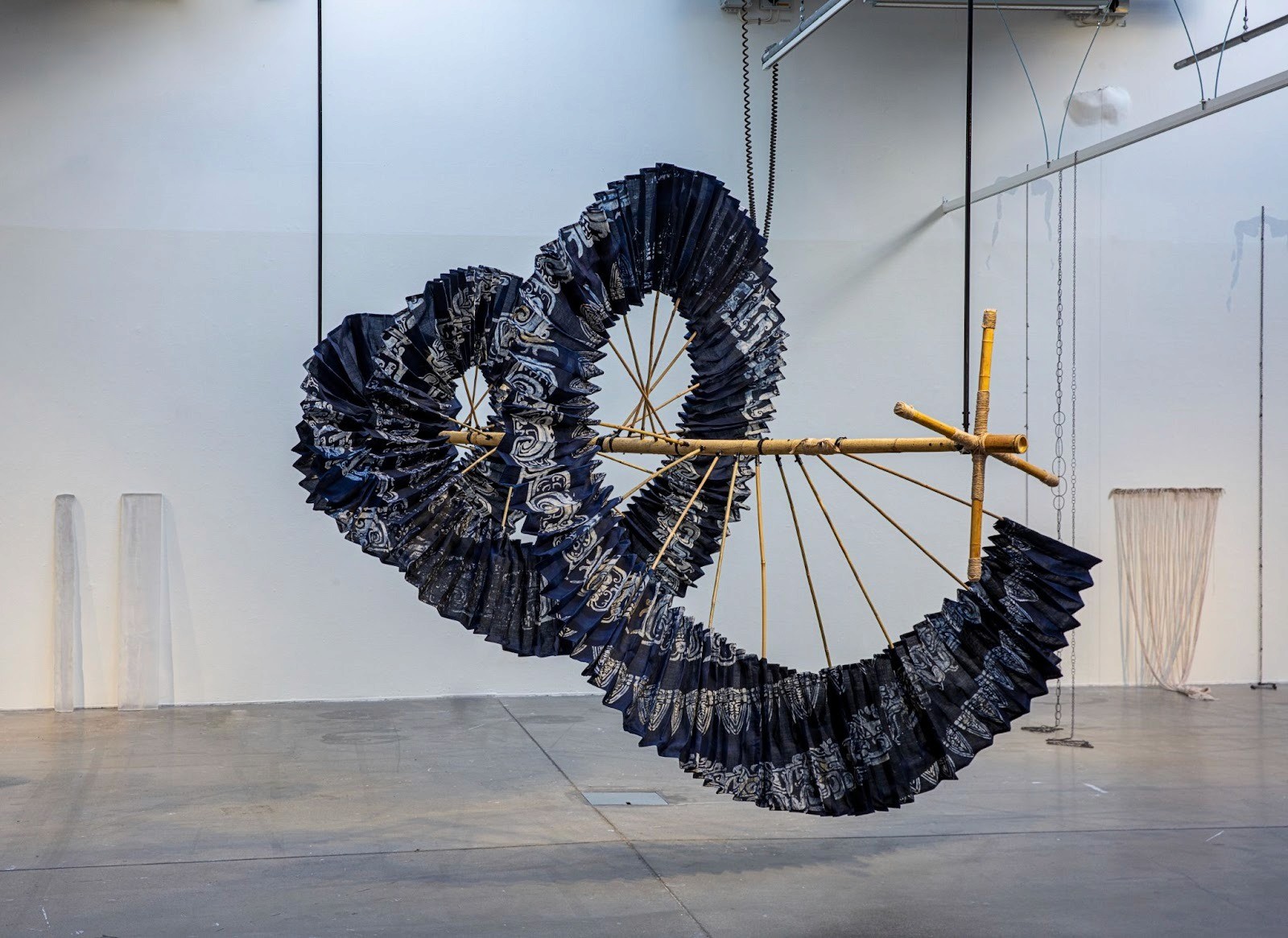
Becoming (2025), photo by Kjell B Persson
Ruoxi: How did you find your way to textiles?
Ting: I went to a preparatory school–Nyckelviksskolan. There I got a chance to try different media, metal, ceramics, textile, painting, wood, plaster, clay, wax etc. I love all of them. But I found my fath in textile.
Textiles are both very deep and very broad. Most importantly, it has a connection to everybody’s daily life. Everyone has some experience with the material, so everyone can create some association with textile work. That’s amazing. If I do something in iron, it’s probably difficult for people to build a connection. But textile has such a long history. There are so many stories to reference, so many cultures to talk about, and those cultures actually connect together.
For example, the peony pattern. It’s common in old Chinese clothes and porcelain. It came to Europe with the porcelain, and people liked it, so they created their own versions. If you look into it, Russian traditional patterns also have peony versions. In Swedish, they still call it “peony” or “Chinese peony.” That’s just one example. Culture floats with textile materials.
There are also so many different raw materials: cotton, silk, hemp, linen, polyester. It grows with human history. There are also many techniques: embroidery, weaving, knitting, sewing, tufting. And it’s not just about the surface. You can do many things with threads. I also learned about bobbin lace. Have you seen how people do bobbin lace? It’s with small sticks, each connected to a thread. You turn them. It’s like double knitting, but sometimes there are hundreds of sticks. The lady just does this very fast. I had to go to Konstfack’s basement to dig out bobbin lace-making books to learn how to do it.
Yul: How do you choose what materials or techniques to work with?
Ting: I don’t choose them. They just come to me. My idea of learning is that if I know everything, I have the freedom to create. I was very thirsty to learn. Now, when I have an idea, I just think, “How do I do this? Oh, I can do this, and this, and that.“
Yul: It seems like you really enjoy making things. Your passion is the core driving force of your practice.
Ting: This exhibition, I gave too much work to myself. I’ve never done so much sewing in my life. In the beginning, I thought about making Fish Tank all by hand because I didn’t want the sewing line to be seen. But time is a challenge.
I experimented with three techniques, french seam, Pojagi and another double seam. As for french seam, you have to sew three seams while Pojagi needs only two. Organza is so delicate and thin; you don’t want to sew many times or it will be twisted. So I thought doing it by hand would be the best. It would look much better, but I didn’t have the time.
Ruoxi: Can you talk about the textile materials you use? You’ve mentioned that most of your textiles are from Asia or have Asian bases.
Ting: The choice of Asian culture related material came naturally to me. I know them well. I have a better connection to them.
And textile materials have historically carried the “code” of women—they are often woven, embroidered, representing a “hidden” history of female labor, resistance, identity and self-expression.
So I project a lot myself onto the material that has Asia origin.
I got almost all my art education in Sweden. It was just like transplanting a plant from another climate. I went through the journey from realizing the cultural difference to identity confusion, then reorientation, and at last I found my way of commodating the two cultures in my art. That piece reflects this integration I finally achieved.
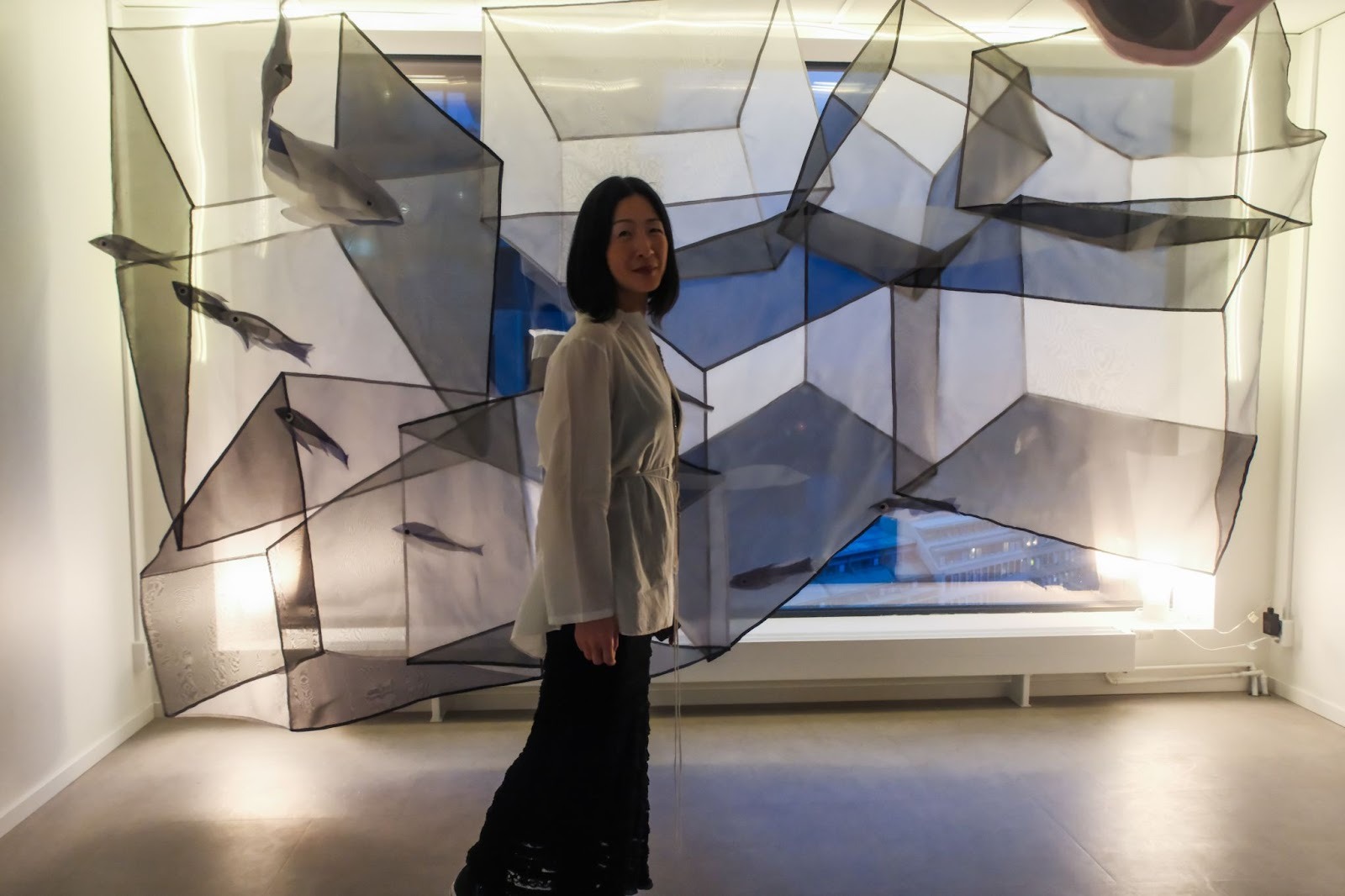
Fish Tank (2026), photo by Letian Lois Ding